Practices Coming Into Focus
How does an emerging photographer establish a distinct critical vocabulary at a moment when billions of digital images are generated daily? Walking through graduate degree shows at the Royal College of Art and London College of Communication, reviewing shortlists for the Foam Paul Huf Award, or browsing the independent dummy tables at Polycopies in Paris reveals a clear answer: new practitioners are interrogating the physical and social apparatus of photography itself.
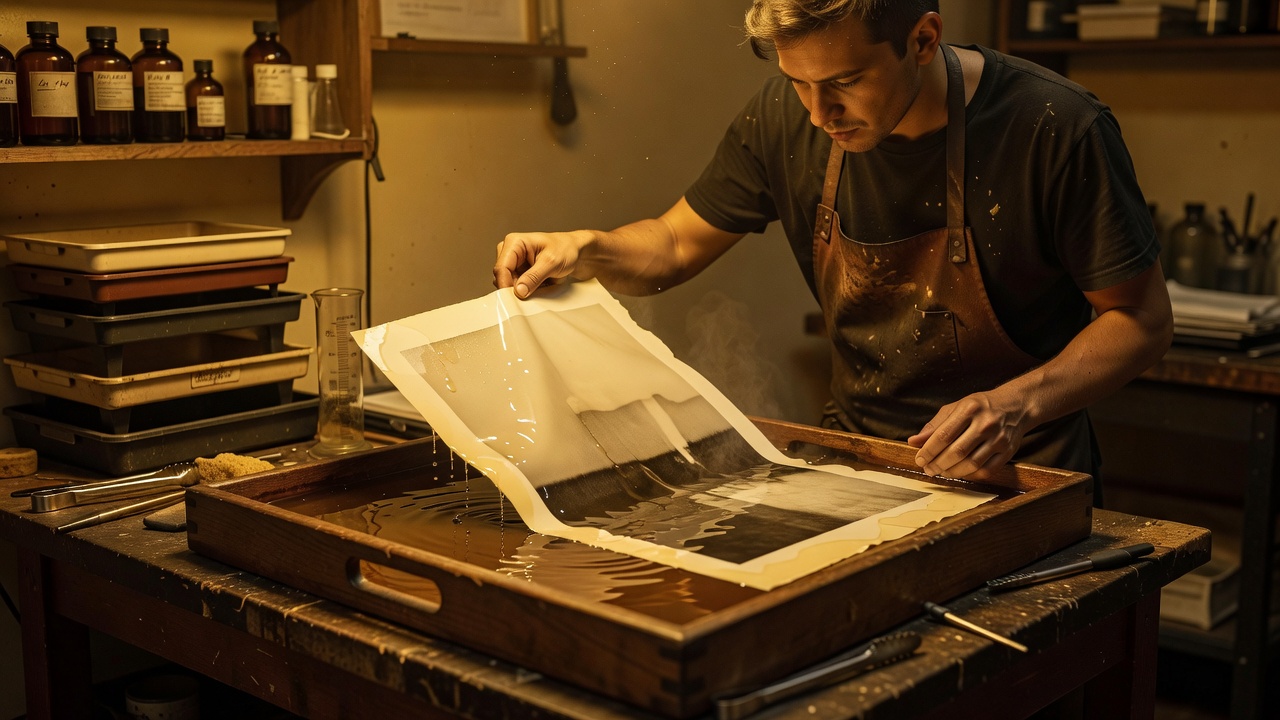
1. The Post-Industrial Darkroom & Ecological Materiality
Reported Fact: Traditional silver gelatin and chromogenic darkroom workflows rely heavily on mined silver, petroleum-derived film bases, and chemical baths containing hydroquinone, metol, and potassium ferricyanide. Over the past decade, artist-run collectives such as The Sustainable Darkroom in the UK have documented and tested low-toxicity, plant-based photographic alternatives.
Editorial Interpretation: For emerging artists addressing climate change, extraction, or river pollution, photographing a damaged landscape with industrial chemicals that further burden watersheds feels like a contradiction in terms. Instead, artists are embedding the landscape directly into the emulsion:
- Phytograms and Plant Developers: Soaking expired silver gelatin paper in phenolic solutions brewed from crushed blackberry leaves, nettles, seaweed, or marsh water collected at the site, so the local biochemistry physically stains and develops the image.
- Anthotypes and Chlorophyll Prints: Utilizing photosensitive plant juices (following the 1842 experiments of Mary Somerville and Sir John Herschel) to create prints that intentionally remain unfixed—requiring exhibition inside drawer cabinets or dim, curtained alcoves.
2. Counter-Archives and Excavated Vernaculars
A second major current among emerging lens-based artists is the critical excavation of institutional and family archives. Drawing intellectual lineage from works such as Sultan and Mandel's Evidence (1977) and Joy Gregory's or Carrie Mae Weems' incisive re-readings of nineteenth-century ethnographic archives, younger photographers are entering municipal storage vaults, defunct commercial portrait studios, and colonial botanical museums.
Rather than treating historical negatives as static truth, these artists photograph the archival folders, the redactions on the back of mounts, and the hands of living descendants holding the prints. In gallery installations, this often takes the form of dual-layer framing: a contemporary high-resolution studio photograph paired alongside a facsimile of an official ledger or a fragile vernacular snapshot.
3. The Photobook Dummy as Primary Exhibition Space
Reported Fact: Major international awards—including the Paris Photo–Aperture Foundation PhotoBook Awards (specifically the First PhotoBook category) and the Kassel Dummy Award—now serve as primary launchpads for curators scouting museum exhibitions.
Editorial Interpretation: For many emerging photographers, the hand-bound photobook dummy comes before the wall exhibition. Designing a book teaches sequencing, typography, paper weight contrast (switching between uncoated Munken paper for text and satin-coated stock for plates), and gatefold pacing. When these projects are subsequently adapted for a gallery room, curators increasingly install reading tables with tethered copies of the book alongside the framed prints, acknowledging that certain intimate narrative arcs function best at reading distance.
"The photobook is no longer a souvenir catalog printed after the show closes; for a whole generation of emerging photographers, the book is the primary architecture, and the gallery wall is its spatial translation."