Witness, Context and Care
When a documentary photograph migrates from the pages of a newspaper or reportage magazine onto the pristine white wall of an art gallery, an ethical shift occurs. In a news publication, the photograph is surrounded by datelines, headline context, and reporter dispatches. Isolated inside a wooden frame under spotlighting, the same image risks aestheticizing crisis or turning a specific historical person into an anonymous symbol.
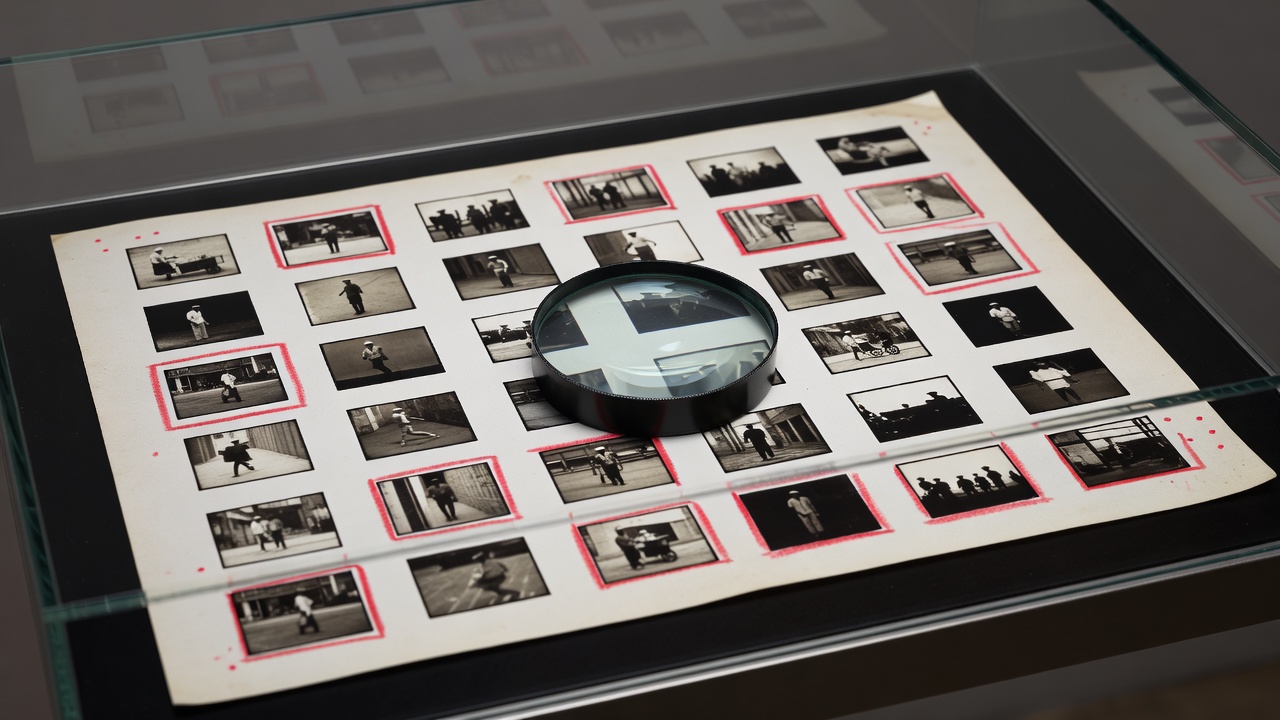
1. The Pedagogical Power of the Contact Sheet
Reported Fact: Beginning with landmark archival exhibitions by Magnum Photos and retrospectives of photographers such as Diane Arbus, Garry Winogrand, Robert Frank, and Josef Koudelka, museums have increasingly displayed 35mm and medium-format contact sheets alongside finished exhibition prints.
Editorial Interpretation: A single framed photograph often looks inevitable, as though reality naturally arranged itself into a balanced rectangle. The contact sheet dispels that illusion. Looking across thirty-six sequential exposures on a single 8x10 sheet reveals how the photographer moved their feet, how the subject reacted to the camera's presence, and what was left outside the final crop. In documentary exhibitions, including the contact sheet is an act of intellectual honesty: it invites the visitor into the editing room.
2. From "Taking" a Portrait to Collaborative Consent
Across contemporary documentary theory—shaped by writers and practitioners from Martha Rosler and Allan Sekula (whose 1978 essay Dismantling Modernism, Reinventing Documentary remains foundational) to Ariella Aïsha Azoulay's concept of the "civil contract of photography"—curators are rethinking how agency is distributed in the exhibition space.
In recent documentary exhibitions at the International Center of Photography (ICP) in New York, Autograph ABP in London, and Fotomuseum Winterthur in Switzerland, we see concrete curatorial shifts that foreground care:
- Co-Authored Wall Labels: Rather than a third-person curatorial summary, subjects write or dictate their own commentary directly on the print border or adjacent label.
- Ongoing Consent Protocols: Exhibiting institutions increasingly clarify whether subjects have given specific permission for their image to be shown in a museum context years after an initial journalistic encounter.
- Contextual Reading Rooms: Placing primary policy documents, maps, timelines, and local journalism in the center of the gallery so viewers do not consume traumatic imagery in a historical vacuum.
3. Verification Standards in an Era of Synthetic Imagery
Reported Fact: Leading documentary competitions and exhibition organizations, notably the World Press Photo Contest and Visa pour l'Image in Perpignan, require entrants to submit untouched camera RAW files (such as CR2, NEF, or DNG) or original film negatives for forensic inspection prior to public exhibition.
Editorial Interpretation: As generative AI tools make synthetic photorealism effortless, the physical documentary exhibition has gained renewed civic importance. When an institution verifies the provenance of a body of work—stating clearly in the exhibition colophon how, when, and under what conditions the exposures were recorded—the gallery becomes a rare public commons of accountable visual witness.
"Care in documentary curation does not mean softening difficult truths; it means refusing to strip a photograph of the political, geographic, and human relationships that brought it into being."