When Images Occupy Space
For much of photography's institutional history, the exhibition wall acted as a neutral window plane: the visitor stood still in front of a rectangle and looked "through" the glass into pictorial depth. Over the past three decades—and with renewed urgency in contemporary gallery programs—artists and exhibition designers have detached the photograph from the perimeter wall, turning the image into a physical, three-dimensional obstacle, canopy, or architectural membrane.
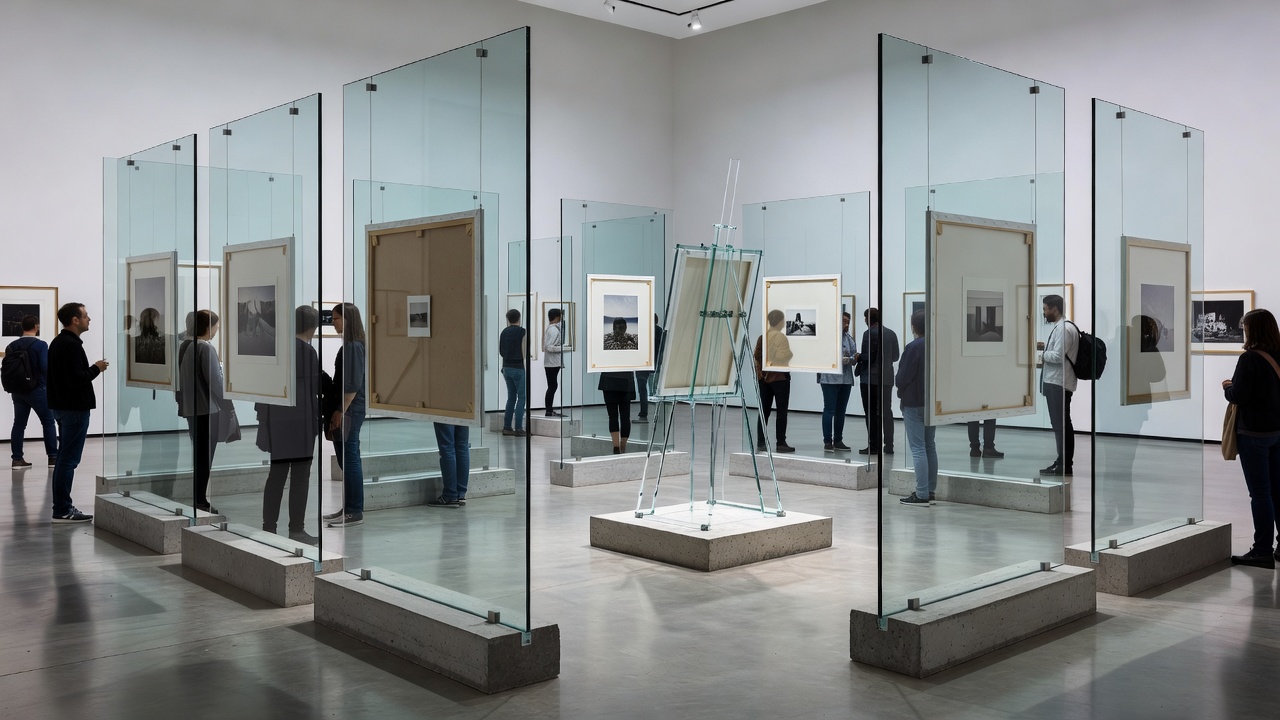
1. The Lineage of the Freestanding Plane
Reported Fact: In 1968, Italian-Brazilian modernist architect Lina Bo Bardi designed the concrete-and-glass easel display system (cavaletes de vidro) for the Museu de Arte de São Paulo (MASP), suspending artworks on clear tempered glass sheets anchored into raw concrete cubes across an open hall. Earlier, Herbert Bayer's 1930 Diagram of 360 Degrees of Field of Vision for the Deutscher Werkbund exhibition in Paris proposed hanging photographic panels at ceiling, floor, and angled overhead heights.
Editorial Interpretation: When contemporary photography festivals—such as Les Rencontres d'Arles (which frequently installs exhibitions inside twelfth-century Romanesque chapels and nineteenth-century railway repair workshops where nails cannot be driven into stone walls)—use freestanding steel or timber armatures, they liberate the viewer from linear wall-following. You no longer walk clockwise around a room; you weave through a forest of images, seeing a close-up portrait in the foreground framed against an architectural landscape twenty feet behind it.
2. Textile Prints, Chiffon Banners, and Airflow
One of the most striking material developments in recent gallery installations is dye-sublimation and pigment printing on semi-transparent silk organza, cotton voile, and industrial mesh. Hung from ceiling joists without bottom weights, these textile photographs respond to the physical presence of the audience. As a visitor walks past, the displacement of air causes the image to ripple gently.
Critically, translucent fabric prints dissolve the boundary between viewer and subject: standing on one side of a suspended silk cyanotype, you see both the photographic emulsion and the ghostly silhouette of another gallery visitor standing on the opposite side.
3. Lightboxes and the Temporal Sculpture of Slide Carousels
Reported Fact: Beginning in the late 1970s, Jeff Wall pioneered the use of large-scale Cibachrome transparencies housed in fluorescent lightboxes modeled on urban bus-shelter advertisements. Simultaneously, artists such as Nan Goldin (The Ballad of Sexual Dependency) and Allan Sekula (Waiting for Tear Gas, 1999–2000) established the 35mm rotary slide carousel as a distinct sculptural and temporal medium.
Editorial Interpretation: Why do contemporary artists continue to seek out discontinued Kodak Ektagraphic 35mm slide projectors when digital laser projectors are quieter and sharper? Because the slide carousel is a sculpture in the middle of the room. Its circular tray of 80 glass-mounted slides has a visible beginning and end; the mechanical clack-whir of the advancing arm acts as a metronome; and the beam of dusty light cutting across the dark room reminds the viewer that a projected photograph is made of light passing through physical celluloid.
"When an exhibition leaves the wall and enters the center of the floor, the visitor's own shadow becomes part of the installation's visual composition."